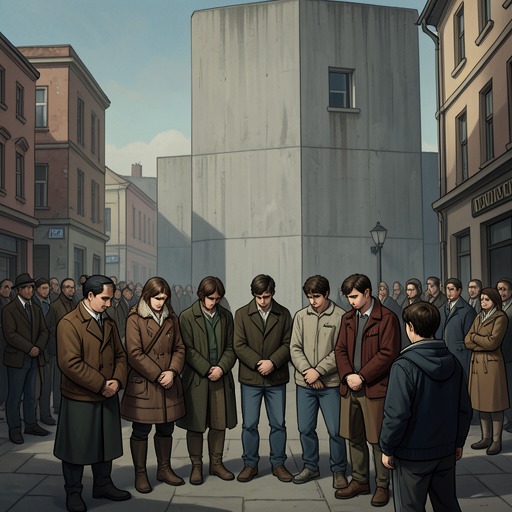
The university strike and police crackdown
Norwegian WoodThe university strike and police crackdown is a turning point in Toru Watanabe’s view of student politics: the promised dismantling of the university ends not in transformation but in restored routines, with its former leaders back in class. Set against Watanabe’s isolation and grief, the episode makes the gap between radical language and consequential action visible, while his response registers a deeper estrangement from the society those students claim they will change.
Causes and Background
The strike begins at the end of May, with students blockading the campus and demanding that the university be dismantled. Watanabe does not share their urgency or political program. At the time, he is emotionally empty and withdrawn: he attends lectures, sits alone in the front row, and has stopped smoking. The strike’s slogan nevertheless strikes him as a possible interruption to a life that feels vacant. He imagines the institution being torn apart and says he is ready to help, not because he has joined the movement’s aims, but because he welcomes anything that might break the prevailing stasis.
Once the blockade suspends lectures, Watanabe takes a job with a delivery company, loading and unloading lorries. The physical work proves harder than he expected, but keeping his body moving gives him a way to forget the emptiness for a time. He works five days a week on the lorries and continues three nights a week at the record shop. The strike thus alters his daily life without drawing him into student organizing: its immediate consequence for him is labor and routine, not political belonging.
The Crackdown and the University’s Return
During the summer holidays, the university calls in riot police. They break the barricades and arrest the students inside. Watanabe regards the intervention as part of the period’s familiar pattern, but the dismantling of the barricades does not amount to the dismantling of the university. He sees the institution as protected by the enormous capital invested in it; it will not simply dissolve because students have occupied it. In his judgment, the protesters themselves had not truly intended to abolish the university. Their aim was to shift the balance of power within its structure, a project he feels no investment in.
In September, Watanabe returns to campus expecting rubble. Instead, the library’s books remain, the tutors’ offices are intact, and the student affairs office has not been burned. His astonishment focuses the episode’s central reversal: the apparent confrontation with the institution has left its physical and administrative life undisturbed. The campus looks as though the barricades and slogans have made no lasting mark.
Lectures resume under police occupation. The first students to take their seats are the very people who had led the strike. They take notes and answer when their names are called, as though nothing has happened. Watanabe finds their return especially revealing because, as he understands it, no declaration ended the strike; the police removed the barricades, but the movement was supposed to continue. He visits former leaders and asks why they are attending lectures rather than carrying on the strike. They cannot give him a straight answer. Their apparent revolution has yielded to the ordinary pressure of attendance and marks, exposing how readily the language of institutional overthrow can give way when everyday incentives return.
Watanabe’s Response and Political Judgment
Watanabe’s reaction is not renewed political commitment but a bitter sense of recognition. He sees the former leaders’ conduct as evidence that their rhetoric has outlasted their willingness to act on it. Their cries for the university’s destruction fade as soon as circumstances shift; in his formulation, a change in the wind turns shouts into whispers. The police have restored the classroom, but the students’ retreat makes the restoration feel less like a defeat imposed from outside than a return the leaders themselves accept.
His judgment is inseparable from his grief. He thinks of Kizuki and concludes that Kizuki is missing nothing in a world where opportunistic students earn good marks and help reproduce the society they once denounced. Watanabe’s anger at political hypocrisy merges with his sense that the larger social order is worthless. The strike therefore fails to provide the break from emptiness he had briefly imagined; its collapse confirms his distance from both collective action and the society it leaves in place.
For a while, Watanabe attends lectures but refuses to answer when the register is taken. He knows the refusal is pointless, yet feels compelled to make it. Its only discernible effect is to deepen his isolation: the other students do not speak to him, and he does not speak to them. This small, private gesture contrasts with the movement’s public slogans. It has no institutional force, but it expresses his refusal to behave as if the restored order were untroubled.
By the second week of September, Watanabe concludes that university education is meaningless. Rather than leave immediately, he recasts it as training in how to deal with boredom. Since he has no particular ambition that requires him to abandon his studies, he continues attending lectures, taking notes, and reading or looking things up in the library. The strike and crackdown do not produce a new political purpose for him; instead, they leave him with a deliberately diminished account of what university life can offer.
Political Theater and Narrative Significance
A later classroom episode echoes the same conflict between institutional routines and radical performance. During a lecture on Euripides and the deus ex machina, two helmeted students enter. One carries political handbills; the other tells the professor that they intend to use the second half of the lecture for political debate, presenting the intervention as an announcement rather than a request. The professor doubts that the world has more urgent problems than Greek tragedy, but recognizes that his objection will not be heard. He picks up his cane and leaves.
The handbills demand that students smash fraudulent elections for university president, marshal forces for a new all-campus strike, and crush the imperial-educational-industrial complex. Watanabe does not object to the stated positions so much as to their stale writing and lack of imaginative force. He judges the speech equally derivative: changing the words has not changed the tune. In his view, the students’ real adversary is not State Power but Lack of Imagination. The scene extends the earlier strike’s critique from failed follow-through to the language itself: political performance may seize a classroom and displace a lecture, yet still fail to make its slogans persuasive.
Midori is present for this interruption. After the professor leaves and the student begins speaking, she tells Watanabe they should go; he stands with her and heads for the door. Their departure gives the episode a concrete counterpoint to the students’ attempt to commandeer the room. The novel places Greek tragedy, political slogans, and Watanabe’s disaffection in the same classroom, where the dispute is not simply whether politics matters, but whether its words and actions can imagine or effect anything beyond the familiar structure they claim to oppose.
Taken together, the crackdown and its echoes distinguish the force of disruption from the achievement of change. Police can clear barricades and restore lectures; student leaders can return to their seats; new militants can repeat familiar slogans. Watanabe’s response remains neither a program nor a strategy for resistance. It is a skeptical witness to the way a movement’s declared ambition can be absorbed back into ordinary institutional life, leaving the university standing and its most dramatic language diminished.